
“Cash is king” is one of those phrases that sounds like wisdom because it’s been repeated so often, but it’s worth asking what it’s actually costing the large number of people who live by it. FCA research found 61% of UK adults with £10,000 or more in investible assets hold at least three-quarters of that money in cash, and one in five hold £25,000 or more in cash specifically. That’s not a small, cautious buffer – for a lot of people, it’s most of their long-term savings sitting somewhere it’s very unlikely to grow in real terms.
Why the instinct is so strong right now
It’s an understandable instinct, and a recent one for a lot of savers. MoneyAge reported that 56% of DIY investors increased their cash holdings between February and April 2025 alone, a full 10 percentage points higher than the switch into cash seen after the October 2024 Budget. Watching a savings balance stay exactly where you left it feels safe in a way that a fluctuating investment balance doesn’t, even when the maths underneath tells a different story.
What “safe” actually costs
The Bank of England’s base rate stands at 3.75%, with CPI inflation at 2.9% as of July 2026. On paper that gap looks like a small real return, but few easy-access accounts actually pay the base rate, and any interest above your Personal Savings Allowance is taxed – for a higher-rate taxpayer, that shrinks the real return further still. Held over a long period, this is how cash quietly loses purchasing power even while the number on the statement keeps going up. Vanguard’s data on UK asset returns from 1901 to 2024 shows why the gap matters over time: global shares returned an average of 5.34% a year in real terms, government bonds 1.36%, and cash 0.89%. Over one year that difference barely registers. Over twenty, it’s the difference between a fund that’s kept pace with the cost of living and one that hasn’t.
Where cash genuinely is the right call
This isn’t a case for holding no cash at all. An emergency fund covering three to six months of essential outgoings belongs in cash precisely because you need to be able to get at it instantly, without worrying whether the market happens to be up or down that week. Money earmarked for a goal in the next year or two – a house deposit, a wedding, a car – sits more comfortably in cash too, since a market fall shortly before you need the money can do real damage with no time left to recover from it. The question isn’t cash or investments; it’s which pot of money is actually doing which job.
Where it usually isn’t
The £10,000-plus sitting in an account earning less than inflation, with no near-term purpose attached to it, is the part worth reviewing. If some of your Cash ISA allowance is also affected by the changes coming in April 2027, we’ve covered what’s changing and what to do about it separately. Beyond that specific change, the broader point stands regardless of which Budget is in force: money with a time horizon of five years or more, and no immediate call on it, is generally better placed working toward inflation-beating growth than sitting still.
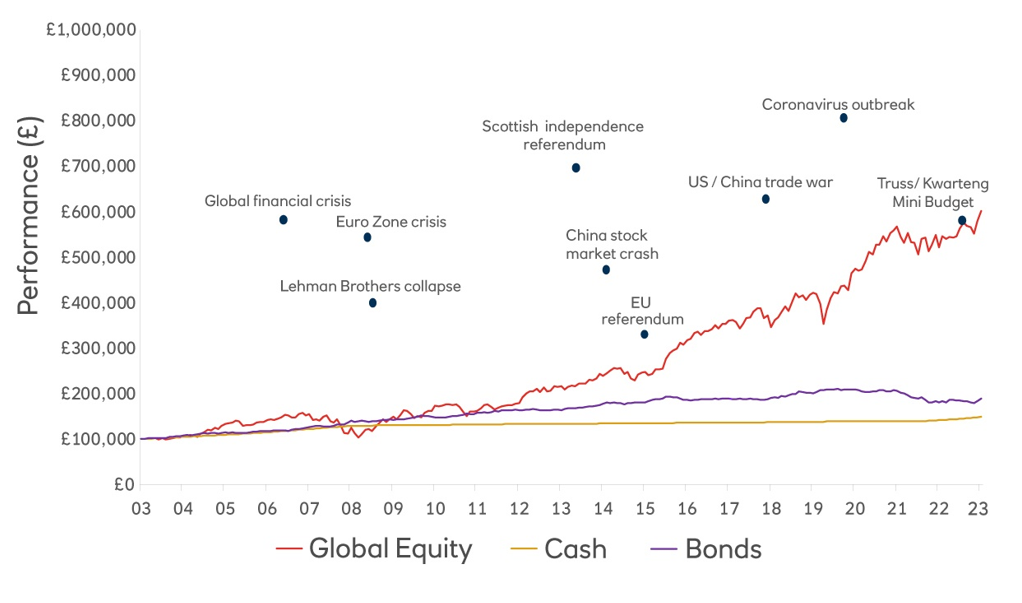
The below graph from NatWest covering the period between 2003 and 2023 highlights this, showing the return on global equities (shares), bonds, and cash at critical points in history. Although cash remains relatively level, the eventual returns from bonds and equities would have been higher.
Let’s look at what your cash is actually for
We work with clients across Poole, Bournemouth and the wider Dorset area to work out how much cash genuinely needs to stay as cash, and what the rest could be doing instead. If you’d like a second opinion on your own balance, get in touch and we’re happy to have a no-obligation conversation.
This article is for general information only and does not constitute financial advice, which should be based on your individual circumstances. The information is aimed at retail clients only. All information is correct at the time of writing (September 2026) and is subject to change in the future.
The value of your investments (and any income from them) can go down as well as up and you may not get back the full amount invested. Past performance is not a reliable indicator of future performance.