

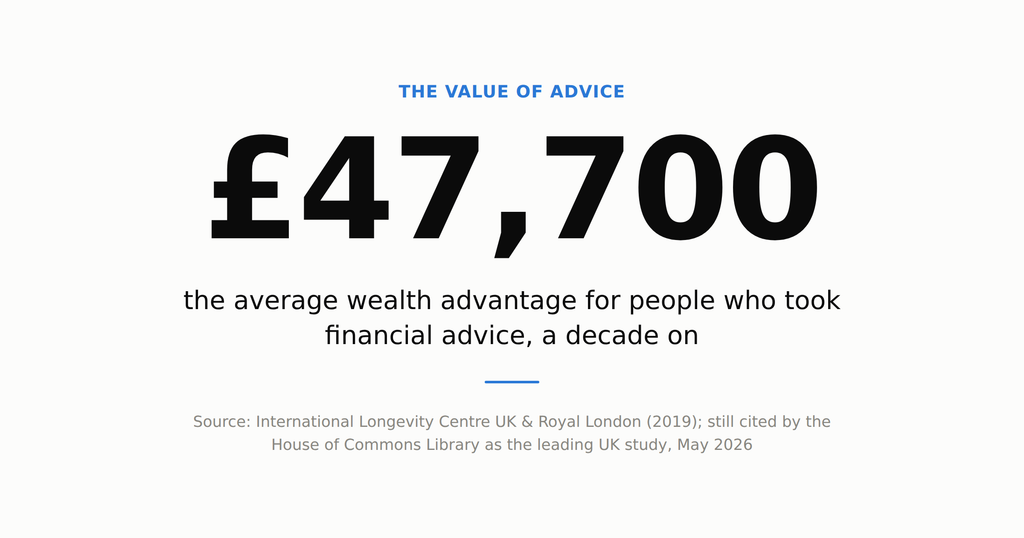
A 2019 study by the International Longevity Centre UK and Royal London, still cited by the House of Commons Library as recently as May 2026, found that people who received financial advice were on average £47,700 better off a decade later than similar people who didn’t. It’s the most-quoted figure in the industry for good reason, but it only tells part of the story. Plenty of research since has looked at what a financial plan does beyond the balance sheet, and the two pictures together make a more complete case than either alone.
The part you can put a number on
A plan usually starts with a goal specific enough to actually work towards – “retire at 60 with a fund that supports the lifestyle I want” gets you somewhere; “retire comfortably” doesn’t. From there it’s a question of which route actually gets you to that outcome, whether that’s how much to divert into a pension each month, or how to weigh a Junior ISA against a general savings account for a child’s future.
Risk plays a bigger part in this than people often expect. Research from Aviva has found that around 18% of women who don’t invest cite risk as their main reason for staying in cash, and more recent aggregate figures from Aviva put the number of people who see investing as “too risky” at around four in ten – often without weighing that risk against what inflation quietly does to money left sitting still. Understanding your own risk profile properly, rather than defaulting to caution or overconfidence, tends to be one of the more concrete things a planner brings to the table.
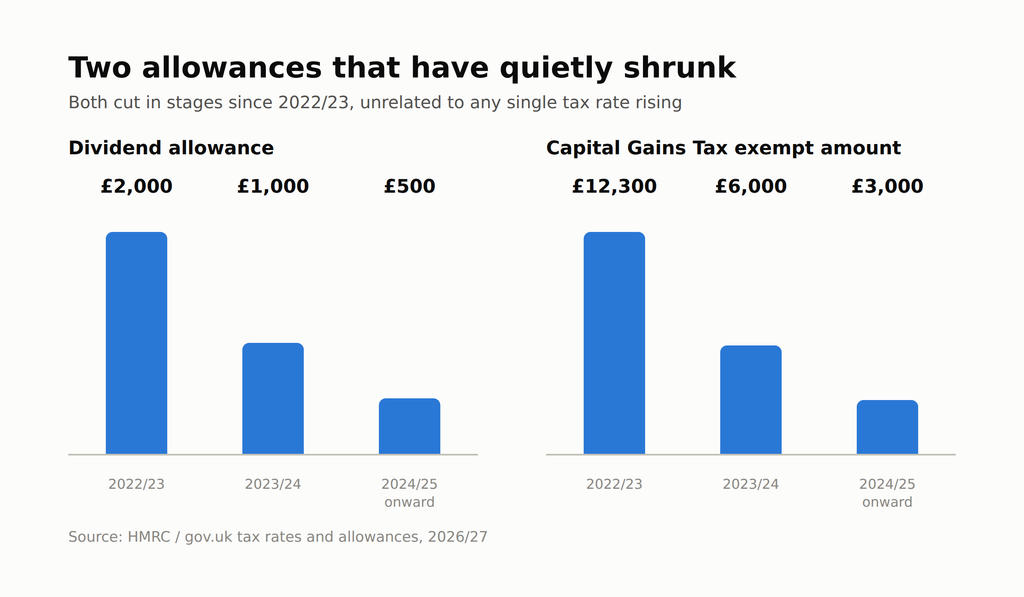
Tax allowances matter too, and they’ve become less generous to ignore. The dividend allowance now sits at £500, down from £2,000 just a few years ago; the Capital Gains Tax annual exempt amount is £3,000, down from £12,300 in 2022/23; and the £20,000 ISA allowance, while unchanged in cash terms since 2017, is frozen until 2031 even as everything else gets more expensive. None of these move in your favour on their own – using them properly is a decision, not a default.
There’s a behavioural piece too, and it’s easy to underrate. Markets fall, sometimes sharply, and the instinct to sell at the bottom is strong precisely when it’s most costly. Having someone whose job is to keep your original plan in view during a downturn, rather than react to the headlines of the week, is worth more than it sounds on paper.
The part that’s harder to measure, but shows up just as clearly
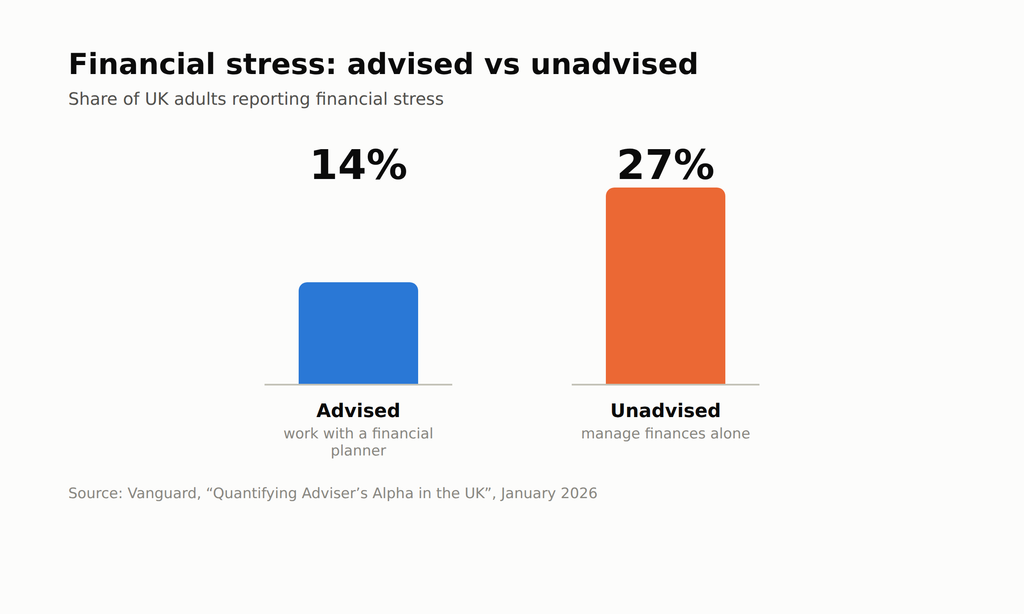
Standard Life’s Retirement Voice research, published in October 2025, found 64% of women and 53% of men say recent economic uncertainty has left them feeling less certain about their financial future. Separately, Vanguard’s UK research into the value of advice, published in January 2026, found that advised clients report financial stress at roughly half the rate of people managing things alone – 14% compared with 27% – and 86% say advice gives them greater peace of mind.
Confidence and knowledge matter here too. Moneybox research from February 2024 found that two-thirds of UK adults believe they’ve missed out on financial opportunities over their lifetime, at an average cost of around £65,000 each – yet only 14% had ever spoken to a financial planner. A lot of that gap isn’t about access to information so much as knowing which of it actually applies to your own situation.
Time is worth mentioning as well. The same Vanguard research found 76% of advised clients say working with a planner saves them time, a median of around two hours a week – time that would otherwise go on researching decisions that someone else can help resolve properly the first time.
People with a plan tend to have a clearer picture of where they’re going
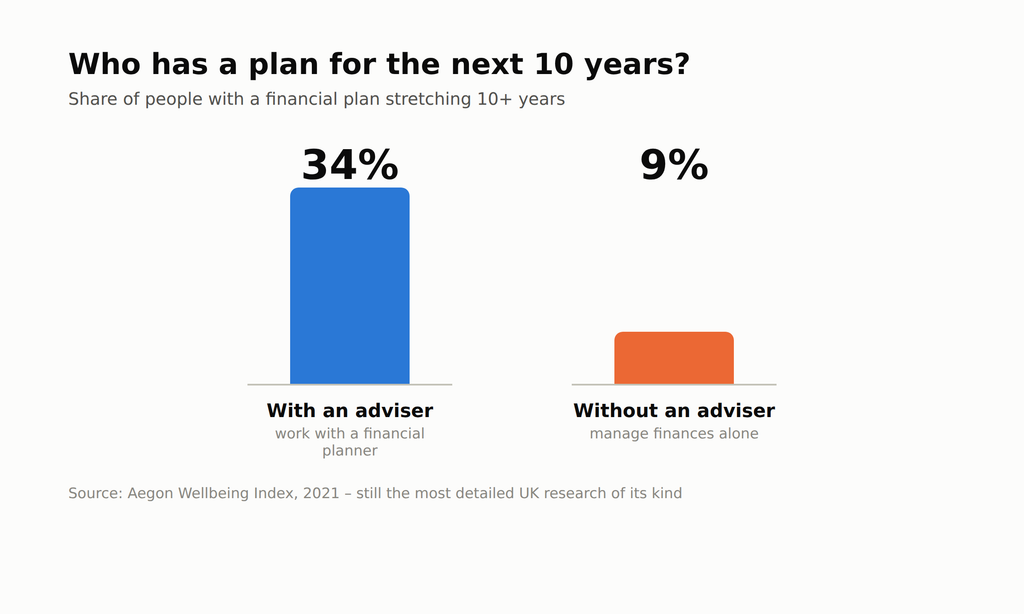
Aegon’s Wellbeing Index, still the most detailed UK research of its kind despite dating back to 2021, found that people working with an adviser were roughly three times as likely to have a financial plan stretching ten years or more, and considerably more likely to describe having a genuinely concrete picture of their life a decade out, compared with those managing things unadvised. That’s really the throughline across all of this: a plan doesn’t just grow money, it gives you something to measure your decisions against, which tends to be exactly what’s missing when finances start to feel like a source of stress rather than a tool.
If it’s the goals themselves you’re still working out, rather than how to reach ones you’ve already set, we’ve written separately about starting from what you actually want your money to do, which is worth a read alongside this.
Let’s find out what a plan could do for you
We work with clients across Poole, Bournemouth and the wider Dorset area on both halves of this – the numbers, and the peace of mind that tends to come with actually having a plan behind them. If you’d like to talk through your own situation, get in touch and we’re happy to have a no-obligation conversation.
This article is for general information only and does not constitute financial advice, which should be based on your individual circumstances. The information is aimed at retail clients only. All information is correct at the time of writing (September 2026) and is subject to change in the future.
The value of your investments (and any income from them) can go down as well as up and you may not get back the full amount you invested. Past performance is not a reliable indicator of future performance.
A pension is a long-term investment not normally accessible until 55 (57 from April 2028). The fund value may fluctuate and can go down, which would have an impact on the level of pension benefits available.
The Financial Conduct Authority does not regulate tax planning.