

Once you’ve set your investment goal and built a strategy around it, the hardest part often isn’t picking the right investments – it’s leaving them alone. Patience doesn’t get talked about as an investment skill nearly as often as it should, yet research from Schroders illustrates just how costly the lack of it can be.
What impatience can actually cost you
Schroders looked at the FTSE 250 over the 35 years from January 1986 to January 2021 and found that £1,000 invested throughout that period, and left untouched, would have grown to £43,595. Missing just the market’s 30 best days over those 35 years – often the days immediately following a sharp fall, when it’s most tempting to have already pulled out – would have reduced that same investment to £10,627, a difference of almost £33,000 in foregone growth. Historical figures like these are illustrative rather than a guarantee of what any future period will look like, but the pattern behind them is a familiar one: the market’s best days tend to cluster around its most volatile periods, and stepping out during that volatility, even briefly, risks missing the recovery that often follows.
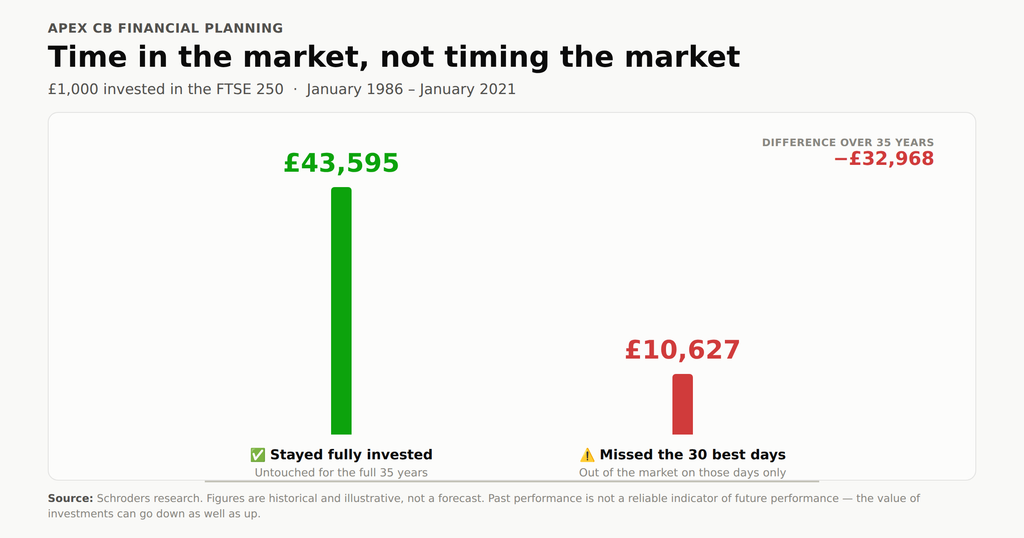
None of this means picking investments or understanding market movements doesn’t matter. It’s simply that, for most investors, sticking to a long-term strategy aligned with your goals and attitude to risk tends to matter more than trying to time when to be in or out of the market.
Five practical ways to build patience into your approach
1. Anchor your strategy to a specific goal
It’s natural to want to reach a financial goal as quickly as possible, but investing rewards a long-term view, and rushing tends to encourage exactly the kind of decisions that undermine it. A clear, goal-based strategy – what you’re investing for, and over what timeframe – gives you something concrete to measure progress against, rather than reacting to how markets are behaving this week.
2. Review on a schedule, not on impulse
It’s never been easier to check the value of your investments – a few taps on your phone will do it. That constant visibility doesn’t necessarily help, though; the more frequently you look, the more tempting it becomes to react to short-term noise rather than long-term progress. Scheduling reviews with your financial planner at set intervals, whether quarterly or annually, gives you a structured way to check you’re on track without the daily distraction.
3. Diversify to make volatility more bearable
Volatility is a normal part of investing, and periods of uncertainty can understandably make you want to act – often by pulling money out at exactly the wrong moment. Spreading your money across different assets, sectors and regions won’t remove risk altogether, but it does tend to smooth out the more extreme swings, which can make it easier to sit tight through a difficult period rather than reacting to it.
4. Know your own triggers
Impatience tends to strike hardest when emotions are already running high – during a volatile week in the markets, or simply when things feel stressful more generally. Recognising the situations most likely to tempt you into a rash decision gives you a chance to pause before acting on it. A simple rule, such as giving yourself 24 hours before making any investment change, is often enough for the initial urge to settle.
5. Automate what you can
Where your strategy involves regular contributions, setting these up to happen automatically – a standing order into an investment account each month, for instance – removes a recurring decision point altogether. There’s less temptation to skip a contribution or change course if it’s already happening in the background rather than requiring an active choice each time.
This matters more the closer you get to needing the money, too. If you’re still years from drawing on your investments, a volatile period is simply something to sit through. If you’re approaching the point where you’ll start relying on that money for income, the temptation to react to short-term falls can be stronger, even though a long-term strategy built around your actual timeframe is usually still the more reliable approach – which is exactly the kind of judgement a financial planner can help you make objectively, rather than in the moment.
Sticking with your plan, wherever you’re investing from
As financial planners based in Poole, we help clients across Bournemouth and the wider Dorset area build an investment strategy suited to their goals and risk profile, and just as importantly, help them stick with it when markets get uncomfortable. If you’d like support with your own investment approach, we’re always happy to have a no-obligation conversation.
Get in touch if you’d like to talk through how patience fits into your own investment strategy.
This article is for general information only and does not constitute advice. The information is aimed at individuals only. All information is correct at the time of writing (September 2026) and is subject to change in the future.
The value of your investments (and any income from them) can go down as well as up and you may not get back the full amount you invested. Past performance is not a reliable indicator of future performance.
Investments should be considered over the longer term and should fit in with your overall attitude to risk and financial circumstances.