
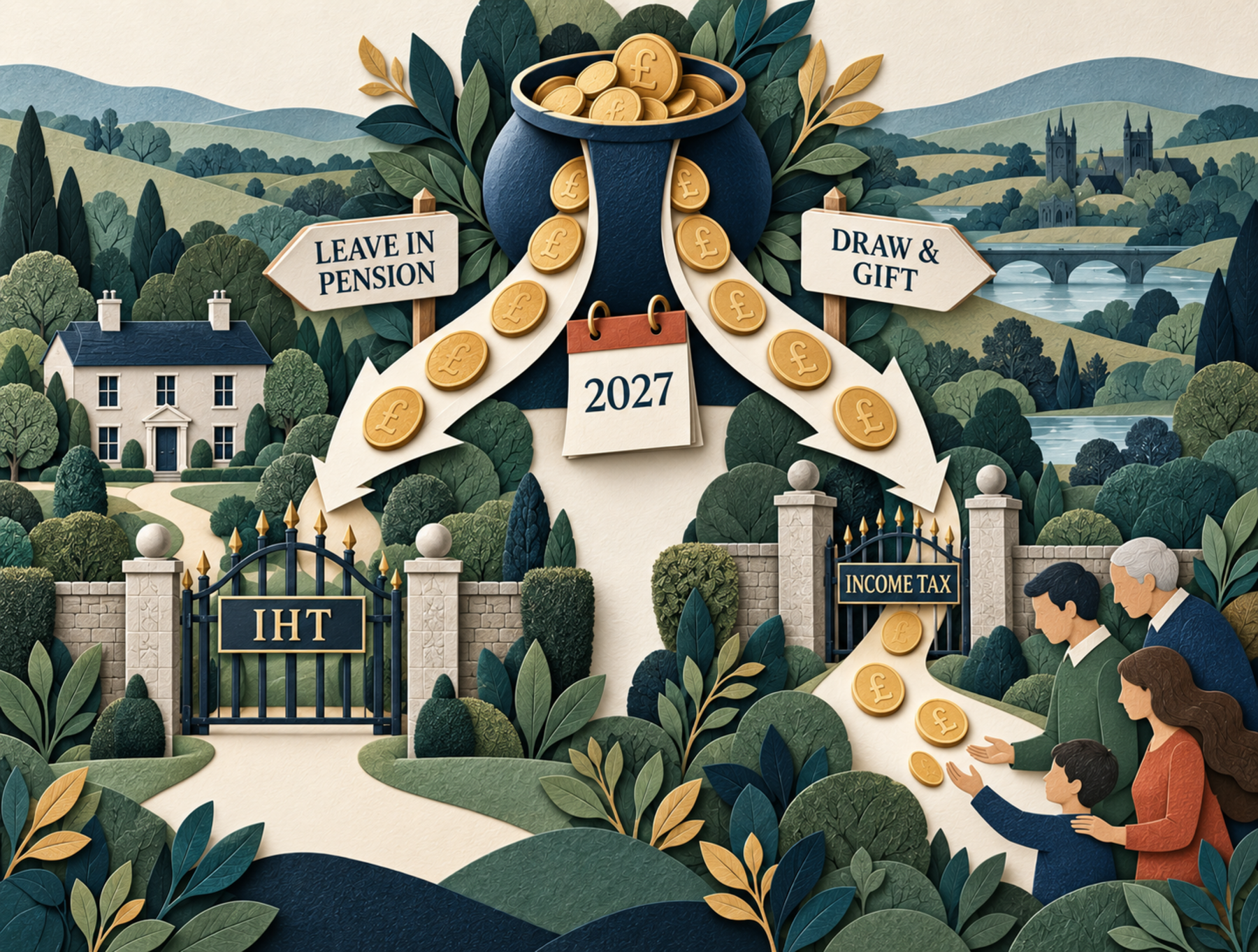
The 2027 Inheritance Tax Changes Explained
This is a significant change to the way many people have approached retirement and estate planning. Until now, defined contribution pensions have often been preserved for beneficiaries because they usually sat outside the estate for Inheritance Tax (IHT). Other savings, investments and ISAs might therefore have been spent first.
That strategy may no longer produce the best outcome after April 2027. However, it does not follow that everybody should immediately withdraw their pension or give money away. The right response depends on the size and composition of your estate, your age, income needs, tax position, family circumstances and appetite for financial risk.
Will my pension become part of my estate?
For deaths occurring on or after 6 April 2027, the value of most unused pension funds and pension death benefits will be brought into the estate when calculating IHT. This includes many defined contribution pensions, whether the funds are uncrystallised or already held in drawdown.
The change does not mean that every pension will suffer IHT. Most estates are still expected to have no IHT liability. Tax normally arises only where the combined value of the taxable estate, including any pension now brought into account, exceeds the available nil-rate bands and exemptions.
The standard nil-rate band is currently £325,000. An additional residence nil-rate band of up to £175,000 may be available when a qualifying home passes to direct descendants, although this allowance is tapered for estates worth more than £2 million. Any unused proportion of these bands may also be transferable between spouses or civil partners, subject to the relevant conditions.
Importantly, the existing exemption for assets passing to a surviving spouse or civil partner will continue. Registered charities also remain exempt. The government has additionally confirmed exclusions for qualifying death-in-service benefits and certain dependant’s scheme pensions from defined benefit or collective money purchase arrangements.
Could my beneficiaries pay both Inheritance Tax and Income Tax?
Yes, in some circumstances—but not every beneficiary will pay both taxes.
IHT is calculated by reference to the deceased person’s estate. Income Tax may then arise when a beneficiary receives or withdraws taxable pension benefits. The Income Tax treatment usually depends on the type of benefit and the age of the pension member when they died.
- If the member dies before age 75: inherited defined contribution pension benefits can generally be paid without Income Tax, subject to conditions including the lump sum and death benefit allowance and relevant payment deadlines. IHT could still apply to the pension value under the new rules if the estate exceeds its available exemptions and nil-rate bands.
- If the member dies aged 75 or over: a beneficiary will generally pay Income Tax at their own marginal rate when taking money from an inherited pension. If the estate is also liable for IHT, both taxes could therefore affect the pension wealth.
- If benefits pass to a spouse or civil partner: the spouse exemption will normally prevent an IHT charge on that transfer, although Income Tax may still apply when taxable inherited pension benefits are drawn.
How might the two taxes interact?
Consider a simplified example in which £100,000 of pension wealth is fully exposed to IHT at 40%. The IHT attributable to that amount would be £40,000, leaving £60,000. If a beneficiary then withdrew that £60,000 and all of it was taxed at 40%, a further £24,000 of Income Tax would arise. The combined tax would be £64,000, or 64% of the original £100,000.
This illustration explains why headlines sometimes refer to a “double tax” on inherited pensions. It is not a universal tax rate. In practice, the calculation could be very different because only part of an estate may exceed the available IHT bands; the beneficiary might draw the pension gradually and pay Income Tax at lower rates; spouse or charity exemptions may apply; and the member’s age at death affects the Income Tax treatment.
Should I draw pension money now?
It may be sensible to reconsider the order in which you use pensions, ISAs, cash and other investments during retirement. In some cases, taking a sustainable income from a pension rather than preserving it untouched could reduce the amount eventually exposed to IHT.
However, withdrawing money simply to move it into a bank account will not usually solve the problem. Once withdrawn and retained, the money will normally form part of your estate anyway. You may also create an immediate Income Tax bill, lose future tax-efficient pension growth and reduce the capital available to support you later in life.
Before increasing withdrawals, it is important to consider:
- your sustainable income requirement throughout retirement;
- Income Tax created by the withdrawal, including whether it pushes you into a higher tax band;
- the loss of tax-efficient investment growth within the pension;
- possible effects on allowances, benefits and your wider tax position;
- investment risk and the danger of running short if you live longer than expected;
- whether an annuity, phased drawdown or a combination of income sources would be appropriate; and
- how your plans would cope with later-life care costs or other unexpected expenditure.
Good planning is therefore less about “emptying the pension” and more about finding the most tax-efficient and sustainable balance between spending, investing and passing wealth on.
Should I withdraw pension money and gift it?
Gifting may be useful where you have more capital and income than you are likely to need. It can allow family members to benefit sooner and may reduce the eventual value of your estate. Nevertheless, pension withdrawals and gifts are two separate tax events and both need to be considered.
The pension withdrawal may be subject to Income Tax. Once you make the gift, its IHT treatment will depend on the exemption or rule being used. Common possibilities include:
- The annual exemption: you can generally give away £3,000 each tax year without it being added to the value of your estate. Any unused annual exemption can normally be carried forward for one tax year.
- Small gifts: gifts of up to £250 can usually be made to any number of people, provided another exemption has not been used for the same person.
- Wedding or civil partnership gifts: specific exemptions may apply, with the amount depending on your relationship to the recipient.
- Normal expenditure out of income: regular gifts may be immediately exempt if they form part of your normal expenditure, are made from income and leave you able to maintain your normal standard of living. Careful records are essential.
- Potentially exempt transfers: larger outright gifts to individuals will generally fall outside your estate if you survive for seven years. If you die sooner, some or all of the gift may still be taken into account for IHT.
It is important not to give away money that you may later need. Gifts are usually irreversible, and continuing to benefit from an asset after supposedly giving it away can prevent it from achieving the intended IHT result.
What should pension holders do before April 2027?
The approaching change is a reason to review your plan, not to make rushed decisions. A useful review should include:
- Estimate the whole estate. Include your home, savings, investments, business or agricultural assets, life policies where relevant and the pensions likely to be brought into account.
- Check the available exemptions and nil-rate bands. This includes any transferable bands from a late spouse or civil partner and whether the residence nil-rate band applies or is tapered.
- Review pension nominations. An expression-of-wish form does not itself remove the pension from IHT under the new rules, but it remains important in helping trustees understand whom you want to benefit.
- Model alternative withdrawal strategies. Compare the likely lifetime Income Tax and eventual IHT consequences of drawing from pensions, ISAs, investments and cash in different orders.
- Consider affordable gifting. Establish what you can give away without compromising your own security, and keep appropriate evidence and records.
- Coordinate your pension, will and estate plan. Pension nominations, wills, trusts, life assurance and investment arrangements should work together rather than being considered separately.
Find out more about our Inheritance Tax planning services here
Frequently asked questions
When do the new pension Inheritance Tax rules start?
They apply to deaths occurring on or after 6 April 2027.
Will every pension be subject to Inheritance Tax?
No. Most unused pension funds and death benefits will be brought into the estate, but IHT will arise only if the taxable estate exceeds the available exemptions and nil-rate bands. There are also exclusions for certain pension benefits.
Will my spouse pay Inheritance Tax on my pension?
Benefits passing to a spouse or civil partner will normally qualify for the spouse exemption, so no IHT should arise on that transfer. The survivor’s own estate may face IHT later, and Income Tax can still apply when taxable pension benefits are drawn.
Does dying before age 75 prevent Inheritance Tax?
No. Age 75 is principally relevant to the Income Tax treatment of inherited pension benefits. Under the new rules, IHT may apply whether death occurs before or after 75 if the estate exceeds its available bands and exemptions.
Can an inherited pension really suffer both IHT and Income Tax?
Yes. This is most likely where the estate is liable for IHT and the pension member dies aged 75 or over, because the beneficiary’s later withdrawals are generally taxable as income. The effective result depends on the estate calculation, the beneficiary’s tax rate and how benefits are taken.
Should I take my tax-free cash before April 2027?
Not solely because of the IHT change. Taking tax-free cash may be appropriate in some plans, but money retained outside the pension normally remains within your estate. You should consider how it will be spent, invested or gifted and whether withdrawing it affects your long-term security.
Will moving pension money into an ISA avoid IHT?
No. ISAs are tax-efficient for Income Tax and Capital Gains Tax, but they are normally part of your estate for IHT. Moving money from a pension to an ISA may change the tax treatment of future growth and withdrawals, but it does not by itself remove the money from your estate.
Do I need to change my pension beneficiary nomination?
It is sensible to check that it remains accurate, particularly after a marriage, divorce, bereavement or other family change. A nomination remains important even though it will not, by itself, keep the pension outside the IHT calculation from April 2027.
Is gifting from pension withdrawals always tax-efficient?
No. You may pay Income Tax to withdraw the money, and the gift may remain relevant for IHT if you die within seven years. Regular gifts from surplus income can be valuable where the conditions are met, but affordability and record-keeping are crucial.
Get tailored help with your pension and estate planning
The 2027 changes make it more important to consider retirement income and estate planning together. The right answer is rarely as simple as preserving the pension, withdrawing it immediately or giving large amounts away.
At Apex CB Financial Planning, we can assess your pension alongside your other assets, model different withdrawal and gifting strategies, and help you build a plan designed to provide for your own retirement while passing wealth to your family as efficiently as possible.
Contact us today to arrange a confidential conversation about how the pension Inheritance Tax changes may affect you and your beneficiaries.
Please note: This article is for general information only and does not constitute personal financial, legal or tax advice. Tax treatment depends on individual circumstances and may change in the future. Pension and estate-planning decisions can have lasting consequences, and you should obtain tailored advice before taking action.
A pension is a long-term investment. The value of investments can fall as well as rise, and you may get back less than you invest. Pension benefits are not normally accessible until age 55, rising to 57 from April 2028, except in limited circumstances.
The Financial Conduct Authority does not regulate tax planning, estate planning, will writing or some forms of trust planning.
Sources: HMRC: Inheritance Tax on unused pension funds and death benefits; GOV.UK: Tax on a private pension you inherit; GOV.UK: Rules on giving gifts. Information checked September 2026.