

A retirement income plan gets tested by two different things over the years it needs to last: how markets behave, and how life behaves. Most planning conversations focus heavily on the first and barely touch the second, which is a problem, because it’s often the second that actually catches people out. This guide covers both – the mechanics of making an income last through a market downturn, and the shocks that have nothing to do with markets at all.
The risk that only appears once you start withdrawing
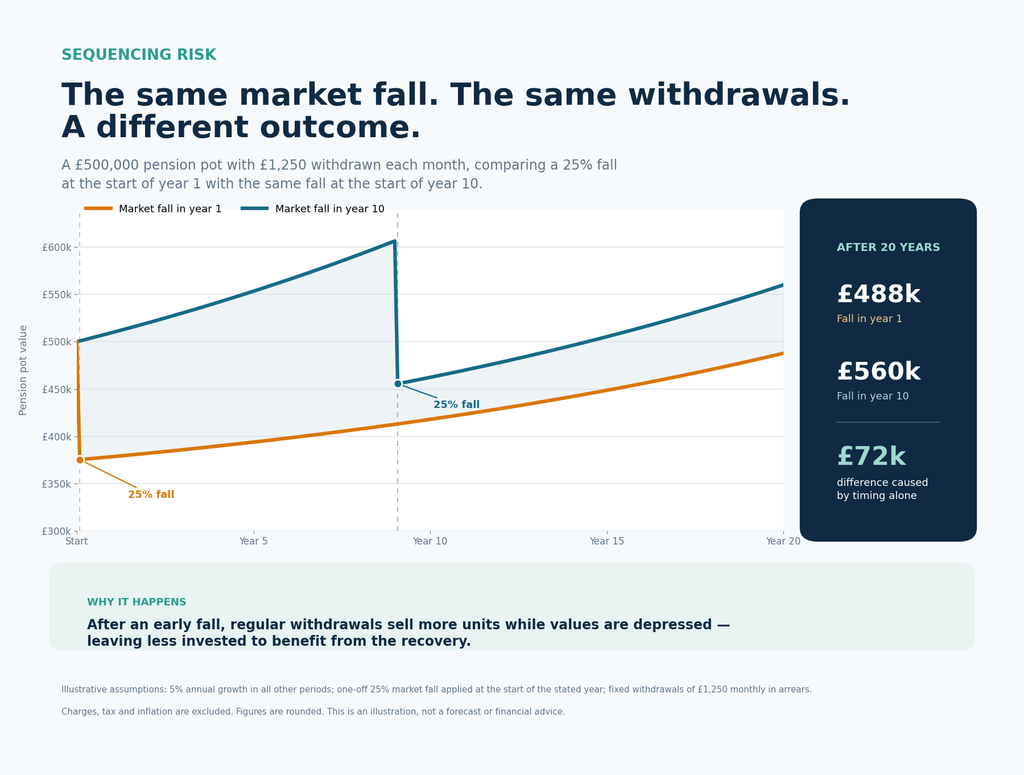
While a pension is still growing, a market fall is rarely something to worry about – there are years, often decades, for markets to recover before the money is needed. Once an income starts being drawn from it, the maths changes. Selling investments to fund income while their value is down locks in a smaller pot permanently, in a way a later recovery can’t fully undo, simply because there’s less of it left to recover with. This is known as sequencing risk, and it’s specific enough that the FCA requires advice firms to stress-test a retirement plan against a market fall happening right at the start of the withdrawal period, not just model steady average growth throughout. A plan that looks perfectly sustainable under a smooth 5% annual return can look very different once a genuinely bad first year or two is built into the same projection.
Building a cash buffer that does a specific job
The standard response to sequencing risk is holding a portion of retirement savings in cash or near-cash, sized to cover essential spending for a set period – typically discussed as somewhere between one and three years – separately from the portion still invested for growth. Advisers sometimes call this “bucketing”: one bucket to draw from day to day, another left alone to keep growing. Research from Hargreaves Lansdown, surveying over 10,000 UK adults, found that 46% of retirees have nothing set aside for unforeseen costs, and that most who do have far less than they assume – only 8% could cover even a month of essential expenses from savings alone if their income stopped. The purpose of a deliberate buffer isn’t to maximise what that portion of the money earns; it’s narrower than that. It exists so a bad year in the market never forces a decision about which investments to sell, at exactly the point when selling them does the most damage.
Why the plan needs revisiting after retirement, not just before
A risk profile set five or ten years before giving up work rarely still fits once an income is actually being drawn from it, and the FCA’s own review of good and poor practice in retirement income advice highlights the same two mistakes repeatedly: plans that only project as far as average life expectancy, which understates how long the money may genuinely need to last given half of people outlive the average, and plans that are set once at retirement and never revisited, running for years on assumptions that were reasonable at the time but have since moved on. A periodic review – checking the assumptions still hold, and that the level of investment risk still matches both the person’s comfort with it and how much of the plan actually depends on it working – catches both.
The shocks that have nothing to do with the stock market
Markets are only one source of risk to a retirement plan, and arguably not the one most people are least prepared for. Ill health tends to bring costs that weren’t part of the original budget – additional heating, more frequent appointments, and potentially care costs that run considerably higher than most people expect – layered on top of whatever income the plan was originally built around. Losing a partner changes the picture in a different, often underappreciated way: a single-life annuity stops paying entirely on death, and even a joint-life one usually drops to a reduced percentage of the original amount, which is far better understood in advance than discovered at the point it happens. And a great many people find themselves wanting to help adult children or grandchildren financially at exactly the point their own income has become fixed rather than flexible – a generous instinct, and often the right one, but one worth checking against the plan first rather than after the transfer’s already been made.
What “lasting” actually means in numbers
It helps to have a concrete benchmark rather than an abstract goal. The Pensions and Lifetime Savings Association puts a moderate retirement income at £31,700 a year for one person or £43,900 for two, and a comfortable one at £43,900 and £60,600 respectively, based on its most recent published figures – a useful yardstick to model a plan against rather than a number to aim for blindly, since the right figure for any individual plan depends entirely on what that person actually spends. Underneath any of these sits the full new State Pension, currently £241.30 a week or £12,547.60 a year, as a guaranteed floor that doesn’t depend on markets at all. We’ve written more on how the State Pension itself works, on how withdrawal decisions affect how long your own pension lasts, and – for a look at how this year’s market swings specifically have tested plans like these – in our piece on building a retirement plan that can survive a recession.
Let’s build a plan around your own numbers
We work with clients across Poole, Bournemouth and the wider Dorset area to build retirement income plans around cash buffers, realistic assumptions and regular review, rather than a single projection set once and left untouched. If you’d like to see how your own plan holds up, get in touch and we’re happy to have a no-obligation conversation.
This article is for general information only and does not constitute financial advice, which should be based on your individual circumstances. The information is aimed at retail clients only. All information is correct at the time of writing (September 2026) and is subject to change in the future.
The value of your investments (and any income from them) can go down as well as up and you may not get back the full amount you invested. Past performance is not a reliable indicator of future performance.
A pension is a long-term investment not normally accessible until 55 (57 from April 2028). The fund value may fluctuate and can go down, which would have an impact on the level of pension benefits available.
The Financial Conduct Authority does not regulate cashflow planning, tax planning, or long-term care fee planning.